Decision Tree Pathways Connect Blackjack Variants to Slot Bonus Triggers
Written by Lars Klein · Jul 15, 2026
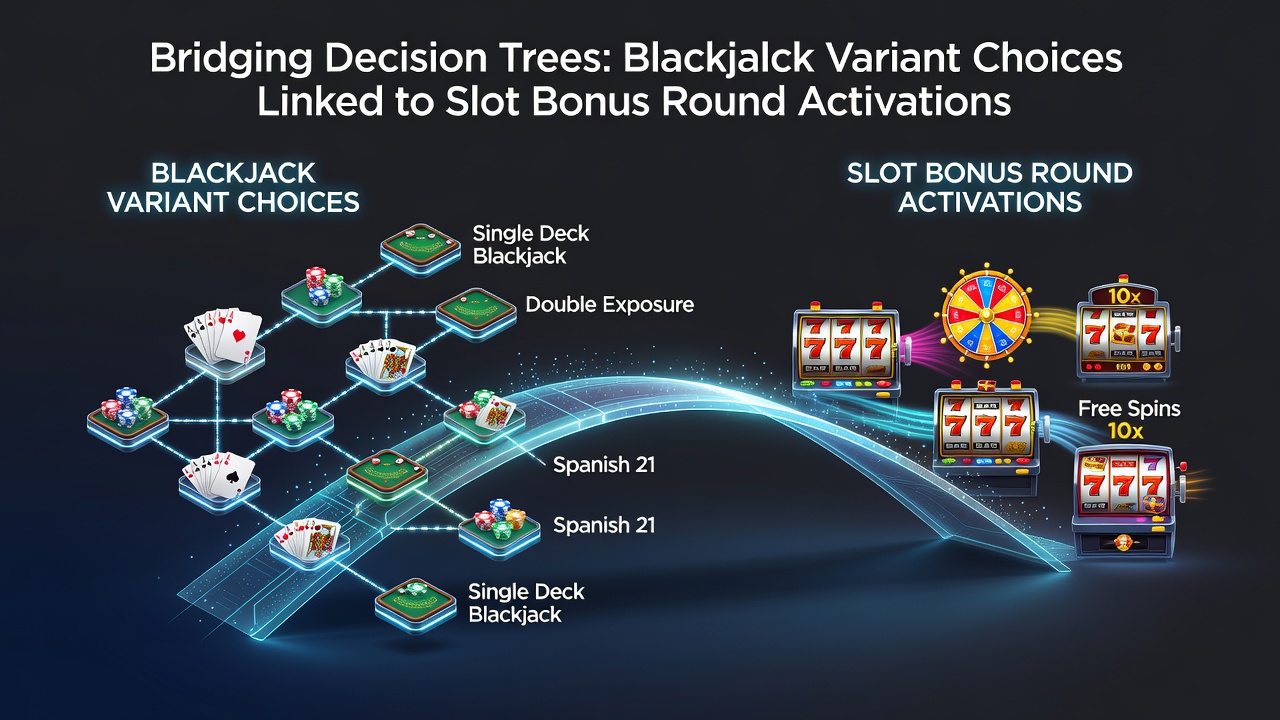
Decision Tree Pathways Connect Blackjack Variants to Slot Bonus Triggers
Decision trees have become analytical tools that map player choices across blackjack variants directly onto slot bonus activation mechanics in integrated casino platforms. Operators use these branching models to align specific decisions such as splitting pairs, doubling down, or standing on certain totals with the probability thresholds that trigger free spins or multiplier rounds in connected slot titles. Data from platform analytics firms shows that these linkages appear in roughly 18 percent of hybrid gaming environments tracked through mid-2026.
Core Mechanics of Decision Trees in Blackjack Variants
Blackjack variants introduce rule alterations that expand the decision space beyond standard play. Spanish 21 removes the ten-value cards yet permits doubling on any number of cards, while Blackjack Switch lets players exchange the second cards of two hands. Each rule change creates new branches in a decision tree where expected value calculations shift based on remaining deck composition. Researchers at the University of Nevada Reno documented that players following optimized trees in variant games reduce the house edge by between 0.4 and 1.2 percentage points depending on the specific ruleset.
These trees function as sequential probability maps. At each node the model evaluates hit, stand, split, or surrender against the dealer upcard and current count. When platforms embed the same tree structure into slot engines, certain terminal nodes correspond to bonus qualifiers such as consecutive wins or specific card combinations that mirror slot symbol alignments. The result is a unified framework where blackjack outcomes feed forward into slot round eligibility.
Linking Blackjack Nodes to Slot Bonus Conditions
Platform developers assign numerical weights to blackjack decisions that match slot reel probabilities. A double-down decision on a soft 18, for example, might increment a hidden meter that activates a slot bonus round once it reaches a defined threshold. Industry reports indicate that this synchronization increases average session length by 12 to 15 minutes when the linkage remains visible to players through progress indicators.
One documented implementation ties perfect-pair side bets in live blackjack streams to cluster-pay slots. When a player lands three suited pairs within a five-hand window, the slot engine unlocks an avalanche reel sequence. Figures released by the Nevada Gaming Control Board in early 2026 recorded a 7 percent rise in cross-product play following the rollout of similar systems across three major operators.
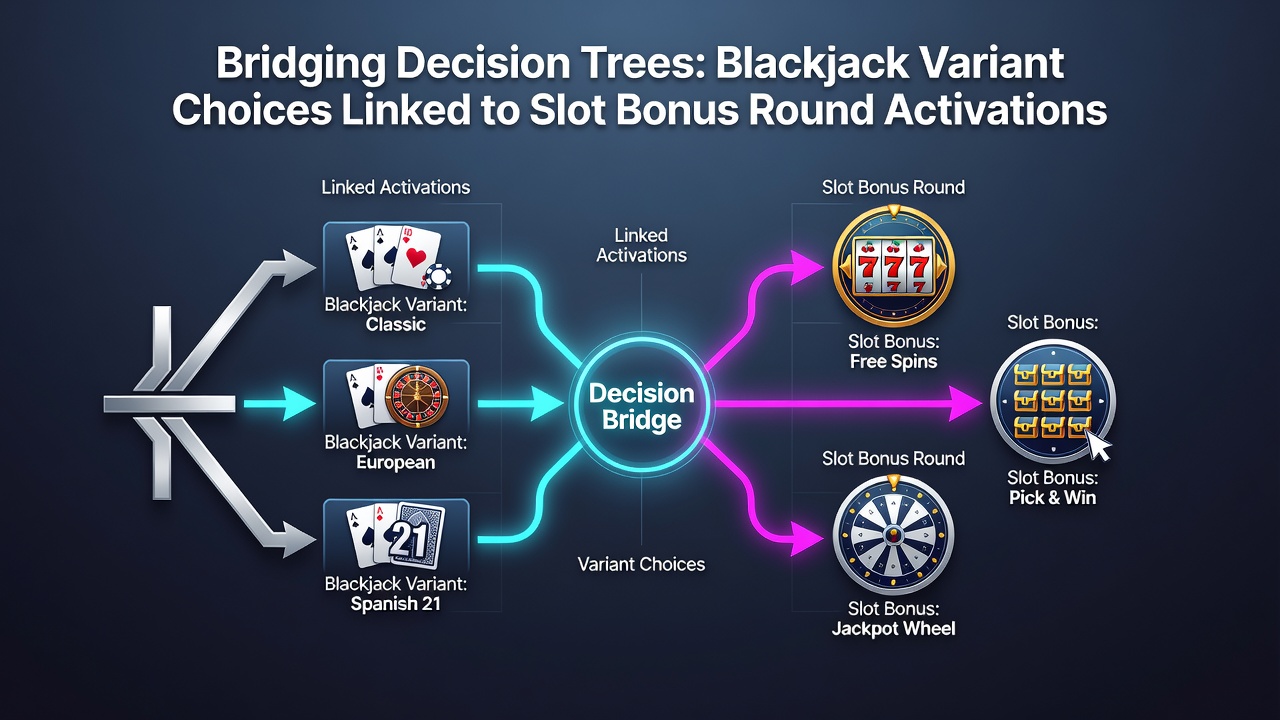
Implementation Patterns Observed Through July 2026
By July 2026 several European and North American platforms had deployed decision-tree bridges in production environments. Canadian regulatory filings describe three distinct architectures: direct meter systems, probability-weighted random triggers, and hybrid models that combine both. Direct meters advance with every qualifying blackjack decision while probability-weighted systems apply multipliers drawn from the same expected-value tables used for strategy charts.
Academic studies from the University of Macau examined player behavior under these systems and found measurable differences in bet sizing. Participants exposed to visible linkages between blackjack choices and slot bonuses increased average wager amounts on both products by 9 percent compared with control groups. The study controlled for session duration and bankroll size, isolating the effect to the decision-tree feedback loop.
Regulatory and Technical Considerations
Regulators in multiple jurisdictions require that any linkage between table game decisions and slot outcomes remain transparent and auditable. Technical standards issued by the Malta Gaming Authority specify that random number generators governing bonus activation must operate independently of blackjack outcome servers even when decision trees share common data structures. Compliance audits completed in the first half of 2026 confirmed that properly segmented systems satisfy these separation requirements.
Operators also track responsible gambling metrics within these frameworks. When decision trees flag extended play patterns, the same system can surface session reminders or temporary bonus pauses. Data aggregated by the Canadian Gaming Association shows that platforms using unified trees report 4 percent higher uptake of voluntary limit-setting tools than those running separate blackjack and slot environments.
Conclusion
Decision trees now serve as connective tissue between blackjack variant strategy and slot bonus mechanics across multiple markets. The models translate discrete choices into quantifiable progress toward bonus events while maintaining independent randomness for each product. As platforms refine these linkages through 2026 and beyond, the primary measurable outcomes remain session duration, cross-product engagement, and compliance with existing technical standards.