Progressive Accumulators Reshape Decision Strategies Across Multi-Hand Blackjack Tables
Written by Lars Klein · Jul 29, 2026
Progressive Accumulators Reshape Decision Strategies Across Multi-Hand Blackjack Tables
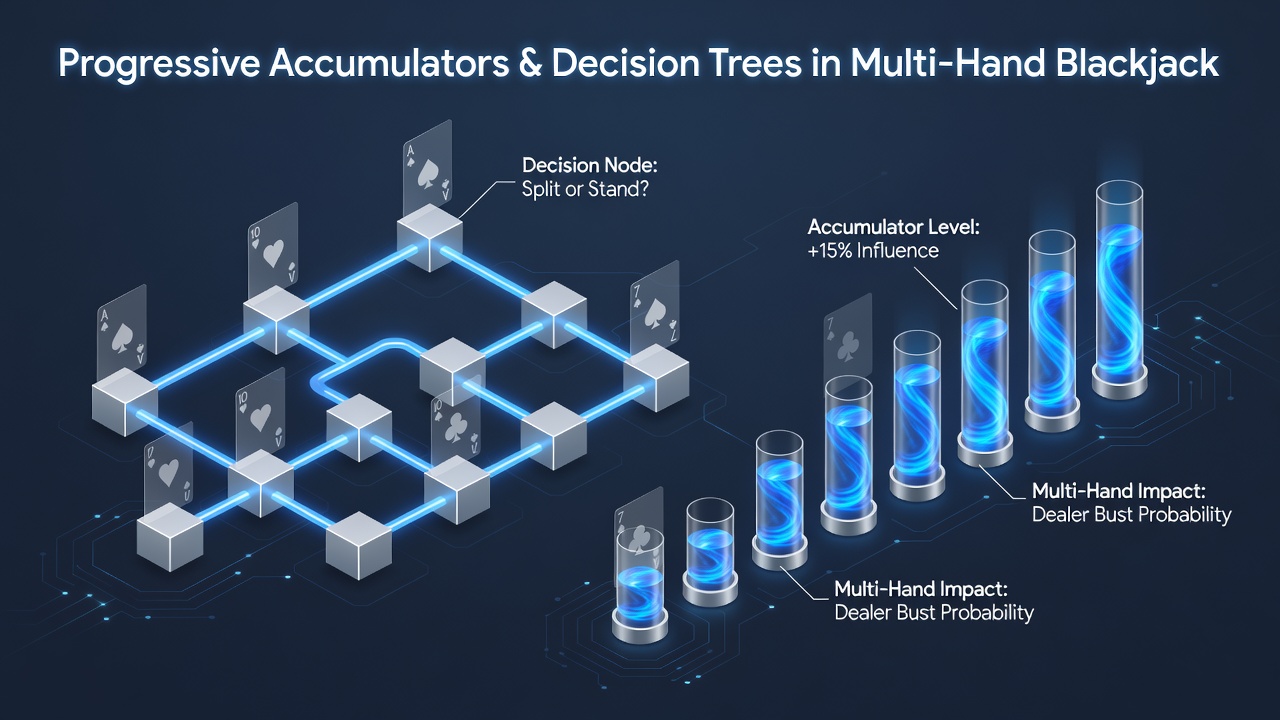
Progressive accumulators add a jackpot layer to blackjack side bets, and this addition directly modifies the expected value calculations that underpin decision trees in multi-hand formats. Operators link a percentage of each qualifying wager to a growing pool, which means players face new thresholds where standard strategy no longer maximizes return. Researchers at the University of Nevada, Reno have documented how these pools alter optimal play points, particularly when multiple hands run simultaneously on the same layout.
Mechanics of Accumulator Contributions in Blackjack
Each side bet placed on a progressive option feeds the accumulator at rates that typically range from 10 to 25 percent of the wager amount. The pool grows until a qualifying hand, such as a suited blackjack or specific pair combination, triggers the payout. Because the accumulator resets or carries over depending on game rules, the current displayed value becomes a variable that decision algorithms must incorporate at every step. Multi-hand play amplifies this effect since a single accumulator often services all active hands, creating shared dependency across simultaneous decisions.
Core Structure of Decision Trees in Multi-Hand Settings
Decision trees for multi-hand blackjack map every possible card combination against dealer upcards, yet they assume fixed payout structures without progressive elements. In practice, these trees expand when accumulators appear because players must weigh the probability of hitting the jackpot against the immediate expected value of hitting, standing, splitting, or doubling. Observers note that software providers now embed dynamic nodes that reference the live accumulator total, shifting recommendations when the pool exceeds certain monetary thresholds.
Adjustments Triggered by Accumulator Growth
When the progressive pool reaches elevated levels, basic strategy charts recommend deviations such as splitting tens against a dealer six or doubling soft totals more aggressively. Data collected from simulation runs at Canadian gaming laboratories show that these shifts occur once the accumulator surpasses roughly 500 times the side-bet unit. In multi-hand sequences the effect compounds because correlation between hands increases the chance that at least one hand qualifies for the top prize. Players therefore encounter revised trees that prioritize jackpot qualification over pure hand-versus-hand optimization.
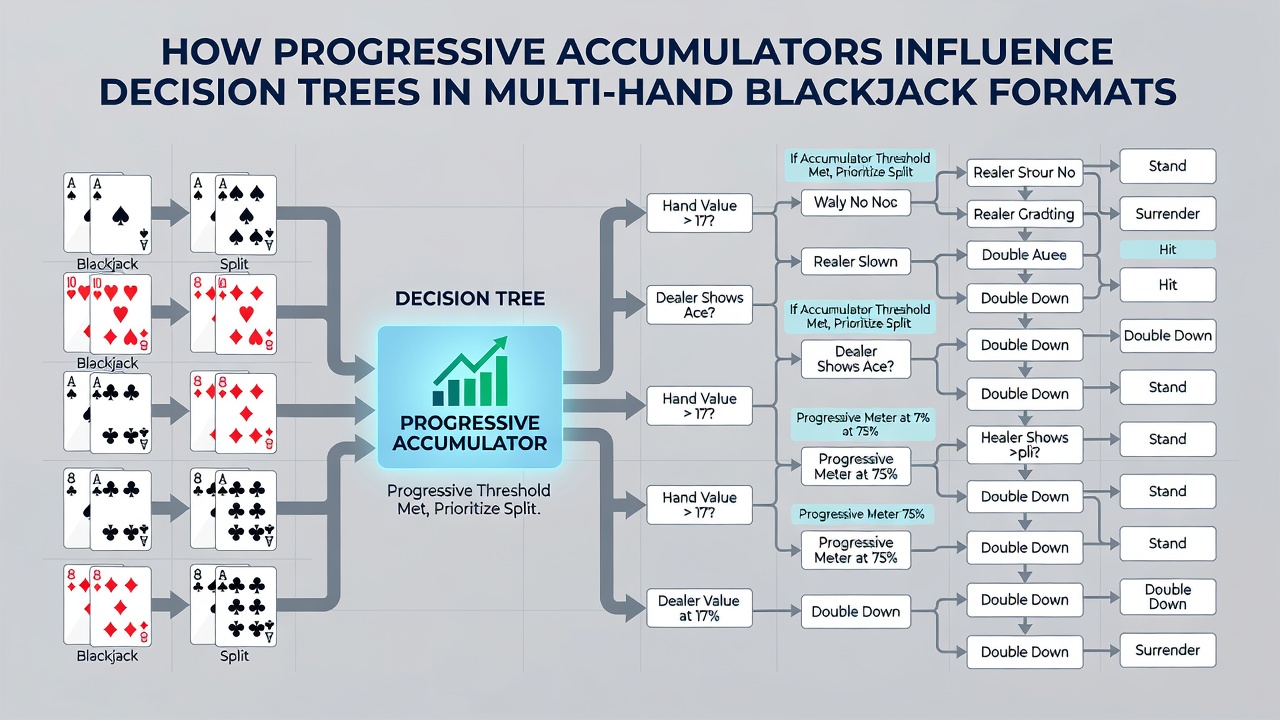
July 2026 updates from European gaming analytics groups indicated that platforms deploying these revised trees recorded measurable changes in average wager duration. The reports linked longer sessions to the presence of visible accumulator meters that encourage continued play until qualification occurs. Decision software accordingly inserts additional branch points that calculate the marginal value of each extra hand in light of the current pool size.
Interaction Between Hand Correlation and Jackpot Odds
Multi-hand formats allow up to three or five simultaneous hands, and this structure introduces covariance that standard single-hand trees ignore. When an accumulator ties into all hands, the probability of triggering the jackpot rises with the number of active positions. Analysts from the New Jersey Division of Gaming Enforcement have recorded instances where optimal play shifts toward more frequent splits and doubles precisely because the correlated outcomes improve overall jackpot access. The updated decision trees therefore contain conditional rules that activate only when the accumulator meter displays values above operator-defined breakpoints.
Implementation Across Platform Variants
Live dealer studios and RNG tables both integrate accumulator tracking, yet the decision support tools differ in delivery. Live environments display meter values on shared screens while players consult handheld strategy cards updated in real time through venue apps. Digital platforms embed the same logic inside autoplay algorithms that reference the live pool before executing each action. Figures released by the Australian Gambling Research Centre confirm that these integrated systems produce statistically significant deviations from legacy trees once accumulator contributions exceed defined percentages of total handle.
Conclusion
Progressive accumulators introduce variable payout potential that forces recalibration of every node in multi-hand blackjack decision trees. The resulting strategies account for jackpot thresholds, hand correlation, and reset mechanics that legacy models never addressed. Continued monitoring by regulatory and academic bodies ensures these evolving frameworks remain grounded in measurable return data rather than static assumptions.